
Logistics
Maybe boxes are stacked in your hallway. Maybe your best salesperson spends afternoons packing orders, or you’re pricing a bigger lease just to hold stock. If so, you’re asking a fair question: is it time to move inventory into a third-party logistics (3PL) warehouse?
This guide is for business owners and operations managers in Edmonton, Calgary, and across Alberta who want a clear, practical answer. It covers:
- Seven warning signs that you’ve outgrown your back room
- A scoring framework for making the call
- A line-by-line breakdown of what switching costs
- A 30-day transition timeline
If you want to see what flexible local storage looks like first, MC Dispatch warehousing holds everything from envelopes to skids with no lease or fixed square footage.
Quick Summary
- A local 3PL warehouse stores, handles, and ships your inventory so your own space and staff can focus on revenue work.
- The clearest signs you’ve outgrown your storage are overflow, lost staff hours, inventory you can’t count accurately, and lease pressure.
- Compare your full in-house cost against a 3PL quote. That means rent, labour, equipment, losses, and delivery, not just rent against a storage fee.
- One-time switching costs include inventory cleanup, labelling, one transport load, and staff setup time.
- Alberta adds its own factors: freezing back rooms and seacans, the Edmonton–Calgary corridor, and seasonal demand swings.
- Most small to mid-sized inventories can move in about 30 days with a phased approach.
- No-contract storage lowers the risk of testing a 3PL before you commit fully.
7 Signs Your Alberta Business Needs a Local 3PL Warehouse
1. Inventory Has Spilled Out of Its Space
Stock that started in one storage room now lives in the office, the owner’s garage, a rented seacan, or the customer-facing area. When storage leaks into working space, it slows everyone down. It also creates safety hazards around walkways and exits.
2. Staff Hours Are Going to Warehouse Tasks
Add up the time your team spends on:
- Receiving freight
- Counting stock
- Packing orders
- Waiting for courier pickups
If people hired for sales, service, or production lose several hours a week to these jobs, you’re paying skilled wages for warehouse work. Online sellers feel this first. Integrated e-commerce fulfillment exists for exactly this problem.
3. You Can’t Trust Your Inventory Count
If answering how many you have requires a walk to the back, something is wrong. Signs include overselling items you don’t have, reordering items you do have, and finding damaged stock months later. The Business Development Bank of Canada describes inventory management as balancing enough stock to meet demand against the cost of holding too much. That balance is hard to strike without an accurate count.
4. You’re About to Sign a Bigger Lease for Storage
A multi-year lease on extra square footage is a fixed cost that doesn’t flex when sales dip. If the main reason for a bigger space is holding product, price outsourced storage before you sign anything.
5. Delivery Demand Is Spreading Across Alberta
Customers in Red Deer, Lethbridge, Grande Prairie, or across the city expect predictable delivery windows. Ad hoc courier pickups from a back room become inconsistent as volume grows. Stock kept with a carrier that runs scheduled deliveries can ship without you arranging each pickup.
6. Your Space Needs Swing by Season
Construction season, oilfield turnarounds, agricultural cycles, and holiday retail all create peaks. If you’re paying year-round for space you only fill a few months a year, flexible storage usually costs less.
7. Product Is Getting Damaged, Lost, or Frozen
Crushed cartons, missing units, and water damage from stacking near doors all cost money. So does winter exposure in unheated rooms. Each loss is a direct hit to margin, and it tends to grow as inventory grows.
The Back Room Breakpoint Score: An Original Decision Framework
Use this scoring method to turn the seven signs into a decision. It’s a general planning tool, not a process any specific provider uses.
Step 1: Score each sign from 0 to 2.
- 0 = not happening
- 1 = happens occasionally
- 2 = happens weekly or constantly
Step 2: Add your total (maximum 14) and match it to a response.
| Total Score | What It Means | Recommended Move |
| 0–4 | Back room still works | Tighten shelving, labelling, and count routines |
| 5–8 | Approaching the breakpoint | Pilot a 3PL with overflow or slow-moving stock |
| 9–14 | Past the breakpoint | Plan a full transition within 30–60 days |
Step 3: Apply the lease tie-breaker. If Sign 4 scores a 2, run the cost comparison below before signing any new lease, whatever your total.
Want real numbers to plug into your comparison? See MC Dispatch pricing or call the Edmonton office at (780) 483-4611 or the Calgary office at (403) 300-0940.
What It Actually Costs to Switch to a 3PL Warehouse
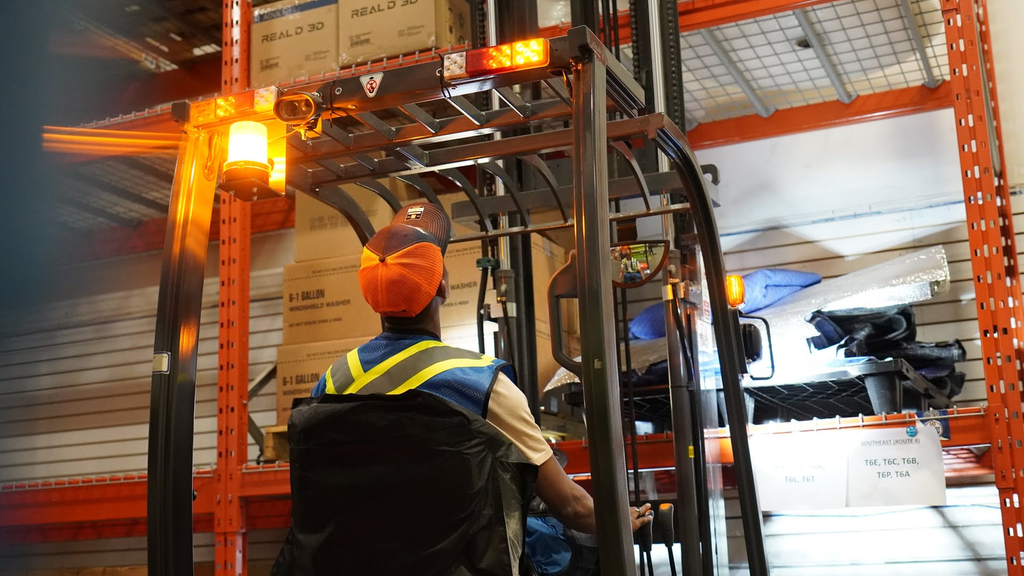
Most comparisons go wrong because owners compare their rent against a warehouse storage fee. A fair comparison counts every cost line.
Ongoing Costs: In-House vs. Local 3PL
| Cost Line | Back Room / In-House | Local 3PL Warehouse | What to Confirm |
| Space | Share of rent or lease, fixed for the term | Billed on space used (pallet, shelf, or unit) | Minimum commitment or contract length |
| Labour | Wages for receiving, counting, packing | Handling fees per receipt, order, or release | How each handling fee is defined |
| Equipment | Shelving, pallet jack, packing station, scale | Built into the facility | Any equipment surcharges |
| Utilities | Heat, lighting, and power for storage area | Built into storage rate | Whether storage is heated |
| Delivery | Courier pickups, staff driving | Dispatched directly from storage | Rates by zone and vehicle size |
| Losses | Damage, shrink, and freeze losses you absorb | Reduced, but not zero | Liability coverage and declared value limits |
| Opportunity cost | Selling space and staff time you give up | Freed for revenue work | Not billed, but real |
One-Time Switching Costs
- Inventory cleanup: Write off or clear dead stock before moving so you aren’t paying to store it.
- SKU list and labelling: Every item needs a clear identifier, description, and handling notes.
- Initial transport: Usually one load. Depending on volume, that’s a van, a 5-ton truck with a power tailgate, or a trailer.
- Staff setup time: Plan several hours to build your order and release process with the warehouse.
- Overlap period: You may keep a small stock of fast movers on-site for a week or two.
- Lease exit costs: Subletting or early termination fees, if you’re downsizing your space.
A Simple Monthly Comparison Formula
In-house monthly cost = storage space cost + (hours on warehouse tasks × loaded hourly wage) + equipment and supplies + delivery + losses
3PL monthly cost = storage + handling + delivery
Here’s an example with placeholder inputs. Replace them with your own figures.
- 500 sq. ft. of storage at an effective $2.00 per sq. ft. per month = $1,000
- 30 staff hours a month at a $30 loaded wage = $900
- In-house subtotal before delivery, equipment, and losses = $1,900
If a 3PL quote for the same volume comes in near or below your full in-house figure, switching usually makes financial sense. If the quote is slightly higher, the freed-up space and staff time may still justify it.
Alberta-Specific Logistics Considerations
These local factors rarely show up in generic 3PL guides, but they affect cost and risk here.
Winter Exposure
Unheated back rooms, garages, and seacans can drop below freezing for weeks. That puts several kinds of product at risk:
- Liquids, paints, and adhesives
- Some foods
- Batteries
- Electronics, which can develop condensation when moved between temperatures
Ask any warehouse how its storage is heated and how cold-sensitive goods are handled in transit.
The Edmonton–Calgary Corridor
MC Dispatch runs Calgary to Edmonton and back every day. That means stock stored in one city can serve customers in the other without a separate freight booking.
Rural and Northern Reach
Province-wide daily runs reach communities including:
- Fort McMurray
- Grande Prairie
- Lloydminster
- Camrose
- Medicine Hat
- Lethbridge
This matters if your customer base extends beyond the two major cities.
Receiving Capability
Many back rooms have no loading dock. Freight arriving on a 53-foot trailer then needs a tailgate truck or manual unloading. A warehouse with proper receiving removes that bottleneck.
Winter Road Delays
Highway closures and storms happen. Keep buffer stock on fast movers from November through March. Check provincial road reports before promising tight delivery dates.
Flexible Terms
MC Dispatch warehousing operates with no contracts. You can store product for 5 days or 5 months and adjust storage requirements as your needs change. That makes a pilot at the 5–8 score level low-risk.
30-Day Transition Timeline: Back Room to 3PL Warehouse
This original timeline suits most small to mid-sized inventories.
Week 1 (Days 1–7): Audit
- Score your business with the Back Room Breakpoint Score.
- Do a full physical count and flag dead stock.
- Pull three months of order data: order count, units per order, delivery destinations.
Week 2 (Days 8–14): Quote and Compare
- Request quotes. Include your SKU count, pallet and carton counts, monthly receipts, order volume, and delivery zones.
- Run the monthly comparison formula.
- Confirm liability coverage, access hours, and how inventory is reported.
Week 3 (Days 15–21): Prepare the Handoff Packet
- Build a SKU sheet with descriptions, dimensions, weights, and a photo of each item.
- Add handling notes such as fragile, keep from freezing, or this side up.
- List the people authorized to release stock and how releases are requested.
- List regular delivery addresses and receiving hours.
Week 4 (Days 22–30): Move in Phases
- Move slow movers and overflow first.
- Reconcile the warehouse receiving report against your packing list within 48 hours.
- Move fast movers last, keeping one to two weeks of stock on-site if needed.
- Go live on outbound orders and review accuracy after two weeks.
Ready to plan your move? Request a warehousing quote from MC Dispatch with your SKU count and monthly volume. You’ll get a comparison you can put straight into the formula above.
Common Mistakes
- Moving dead stock. Clear obsolete inventory before transport so you don’t pay to store it.
- Comparing only rent against the storage fee. Labour and losses are often the highest in-house costs.
- Skipping a written release process. Without named authorized contacts, stock can leave without approval.
- Not reconciling the first receipt. Count discrepancies are easiest to resolve in the first 48 hours.
- Moving everything at once during peak season. Phase the move during a slower period if possible.
- Forgetting to flag freeze-sensitive items. Handling notes must travel with the SKU sheet.
- Signing a bigger lease before testing outsourced storage. A no-contract pilot costs far less than an unused lease.
What To Do If Something Goes Wrong
Count Discrepancy After Receiving
Compare your packing list line by line against the receiving report. Request a recount of the specific SKUs in question, and share photos of labels to rule out look-alike products.
Damaged Goods
Photograph the damage and keep the packaging. Report it the same day and review the declared value terms you agreed to.
Late or Missed Delivery
Request tracking details and proof of delivery. Confirm the address and receiving hours on file. If weather caused the delay, update your customer with a revised window.
Wrong Item Shipped
Check whether two SKUs look alike. Add photos and clearer descriptions to your SKU sheet.
Unexpected Stockout
Review your reorder points. Add the supplier-to-warehouse lead time you may not have tracked when stock came straight to your door.
Frequently Asked Questions
What is a 3PL warehouse?
A 3PL (third-party logistics) warehouse stores your inventory and handles receiving, storage, and outbound shipping for you. Instead of managing stock in your own space with your own staff, you send product to the provider and request releases or deliveries as orders come in.
How do I know if my business is too small for a 3PL warehouse?
Businesses with even a handful of pallets can benefit if storage is eating into working space or staff time. Score your business on the seven signs in this guide. A total of 5 or more usually justifies at least a pilot.
How much does 3PL warehousing cost in Alberta?
Costs depend on how much space you use, how often product is handled, and where it’s delivered. Most quotes combine storage, handling, and delivery charges. Compare a quote against your full in-house cost, including labour and losses, not just rent.
Do I need to sign a long-term contract to use a 3PL?
Some providers require minimum terms, so confirm before committing. MC Dispatch warehousing has no contracts, so you can store product for days or months and adjust storage needs as your business changes.
How long does it take to switch from in-house storage to a 3PL?
Most small to mid-sized inventories can move in about 30 days with a phased approach. Allow one week each for auditing, quoting, preparing documentation, and moving stock.
Can a warehouse in Edmonton serve customers in Calgary?
Yes, if the provider runs regular service between the two cities. MC Dispatch runs Calgary to Edmonton and back every day and operates daily runs to other Alberta communities.
What should I send a new warehouse before moving my inventory?
Send a SKU sheet with descriptions, dimensions, weights, and photos, plus handling notes for fragile or freeze-sensitive items. Include a list of authorized contacts, your release process, and regular delivery addresses.
Conclusion
Outgrowing the back room is a sign of growth, but it gets expensive if you ignore it. Score your business against the seven signs and run a full cost comparison, not a rent-only one. Then move in phases so you don’t disrupt your customers. For Alberta businesses, choose a warehouse partner that can handle winter conditions, the Edmonton–Calgary corridor, and deliveries across the province.
MC Dispatch offers no-contract warehousing with daily delivery runs across Alberta. You can store as little as one pallet and adjust as your business changes. Contact MC Dispatch or call (780) 483-4611 in Edmonton or (403) 300-0940 in Calgary for a quote.