
Courier ServicesLogistics
If you sell or distribute products in Alberta, every shipment involves two decisions: who handles the orders, and which vehicle moves them. Getting either one wrong costs you. You lose staff hours packing boxes, or you book a truck that’s too small, too big, or can’t unload at the destination.
This guide is for Alberta business owners, online sellers and operations managers who want a clear answer on both. You’ll learn when outsourced e-commerce fulfillment makes more sense than shipping yourself, and how to choose between a cargo van, 5-ton truck, flat deck and 53′ trailer based on size, weight, loading access, season and timing.
Quick Summary
- Self-shipping works while order volume is low and predictable, and your team has time to pick, pack and book carriers.
- Outsourced fulfillment starts to pay off when packing cuts into sales time, storage runs short, or peak seasons cause missed cutoffs.
- Choose a truck based on floor space, weight, loading access, weather exposure and urgency. Box count alone is not enough.
- Cargo vans suit parcels and cartons. 5-ton trucks carry up to about 12 skids and have a power tailgate for sites without a dock.
- Flat decks handle long, heavy or awkward freight such as pipe and machinery that loads from the side or top.
- 53′ trailers suit full loads of roughly 24 pallets and work best with a dock or forklift at both ends.
- Alberta factors can change the right vehicle choice. These include spring road bans, winter conditions and rural delivery access.
E-Commerce Fulfillment vs. Self-Shipping: What You’re Deciding
With self-shipping, your team stores inventory, picks and packs orders, prints labels, and books a courier or freight carrier for every outbound load. With outsourced fulfillment, a logistics provider stores your stock, processes orders as they arrive and hands them directly to delivery drivers.
Neither option is cheaper by default. The answer depends on order volume, product type, and how much of your team’s week goes to shipping.
When Self-Shipping Still Makes Sense
- One person can pack your daily orders in a few hours.
- Products are custom, made to order, or need inspection before they leave.
- Most outbound freight is occasional bulk loads to a small number of business customers.
- You have storage with a dock or forklift, or reliable ground-level access.
When Outsourced Fulfillment Is Worth Pricing Out
- Packing and booking shipments regularly pull owners or salespeople away from revenue work.
- Inventory is overflowing into offices, garages or rented extra space.
- Orders spike around Black Friday, the holidays or product launches, and you miss same-day cutoffs.
- Stock arrives in pallets, but it goes out as single parcels to consumers across Edmonton, Calgary and smaller centres.
In that last situation, a combined warehouse and delivery setup helps most, because inbound freight and outbound orders are handled in one place. MC Dispatch’s e-commerce fulfillment service covers storage, packaging and shipping for online sellers in Alberta.
Many businesses choose a hybrid. They outsource consumer parcel orders and keep booking trucks directly for bulk B2B loads. Either way, you still need to know which truck fits.
Van, 5-Ton, Flat Deck or 53′ Trailer: Side-by-Side Comparison
The capacities below come from MC Dispatch’s published fleet specifications. Other carriers’ equipment varies, so confirm dimensions before you book.
| Vehicle | Published Capacity | Best For | Loading Needs | Watch Out For |
| Cargo van | Small and medium packages and boxes | E-commerce parcels, documents, small parts | Hand-carried | Not built for pallets |
| 1-ton truck | 16 ft box, up to 4,000 lbs, about 7 skids | Small pallet loads, height-restricted sites | Forklift at both ends | Limited floor space |
| 5-ton truck | Box up to 26 ft long, 8 ft wide, 8 ft high; about 12 skids | Multi-pallet drops to stores, homes and job sites | Hydraulic tailgate lifts to 2,000 lbs | Pieces over 2,000 lbs need a forklift |
| Flat deck | 24′ and 30′ bumper-pull decks | Pipe, steel, lumber, machinery, oversized items | Forklift, crane or telehandler from side or top | Weather-sensitive freight needs tarping |
| 53′ dry trailer | About 24 full-size pallets, up to 60,000 lbs | Full truckloads, warehouse transfers | Dock or forklift at both ends | Needs manoeuvring room and a receiving dock |
Cargo Vans
Vans are the standard choice for e-commerce parcels. They fit downtown loading zones and residential streets, and they handle multi-stop routes efficiently. If one person can carry each carton, a van is almost always the right vehicle.
5-Ton Trucks
The 5-ton is the main option for multi-pallet deliveries to places without a dock. MC Dispatch’s 5-ton service uses enclosed box trucks with hydraulic power tailgates, so drivers can lower pallets to ground level at a store, jobsite or home. Each pallet must stay under the 2,000 lb tailgate limit.
Flat Decks
Choose a flat deck when an item is too long, heavy or irregular for an enclosed box, or when it must be loaded by crane or from the side. Flat deck services cover piping, heavy equipment and tarped loads that need weather protection.
53′ Trailers
For full loads between warehouses, or from a supplier to your facility, one 53′ trailer trip can replace several smaller-truck trips. The 53′ trailer and dry LTL service handles both full truckloads and less-than-truckload freight.
The FIT-5 Method: A Framework for Choosing the Right Truck
Work through these five questions in order. Each one can rule out a vehicle before you request a quote.
- Footprint. Count floor positions, not boxes. Measure each pallet’s length and width and note whether it can be stacked. Ten non-stackable pallets need ten floor spots.
- Individual and total weight. Record both the total weight and the heaviest single piece. The heaviest piece tells you whether a tailgate will work. The total tells you which truck class you need.
- Transfer at each end. Find out whether the pickup and delivery sites have a dock, a forklift, or ground-level access only. Ground level with no equipment points to a van or tailgate truck. Crane or side loading points to a flat deck. Docks at both ends make a trailer practical.
- Exposure. Ask whether the freight can get wet, dirty or frozen. Use an enclosed vehicle for anything sensitive. Use a flat deck only for freight that can be tarped or handles weather well.
- Timing. Decide whether the load is same-day, scheduled or recurring. Urgent loads justify a dedicated vehicle. Flexible loads can often ride on scheduled regional runs or LTL.
Quick Decision Rules
- Hand-carried cartons, no pallets: cargo van
- 1 to 7 skids, forklift at both ends, low headroom: 1-ton
- Up to about 12 skids, or no dock at delivery: 5-ton with tailgate
- Long, heavy or crane-loaded items: flat deck
- More than 12 pallets, or dock-to-dock transfers: 53′ trailer, full load or LTL
As a working rule, leave 10 to 15 percent of floor space unused so there’s room for securing the load and odd-sized pieces.
Not sure which vehicle your load needs? Check MC Dispatch’s pricing page, or send your pallet count, weights and addresses to get a quote matched to the right truck.
Alberta Factors That Can Change Your Truck Choice
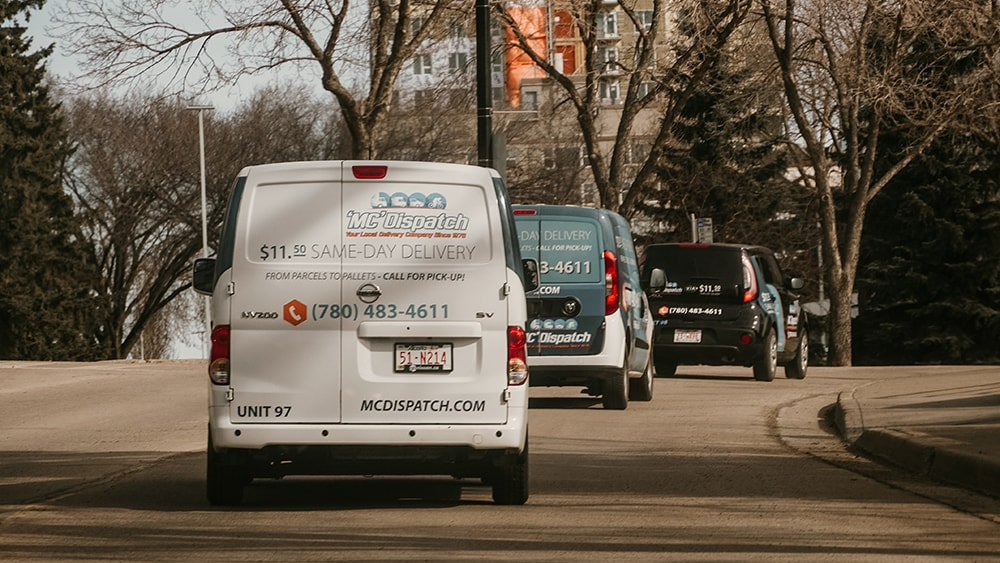
Spring Road Bans and Seasonal Weights
During spring thaw, allowable axle weights drop on many provincial and local roads to prevent damage. Heavy deliveries to acreages, farm yards or county roads may need to be split across smaller vehicles or moved to a later date. Before booking heavy spring deliveries, check the Government of Alberta’s road restrictions and bans page, and contact the county or municipal district for local roads.
Winter Conditions
From about October to April, cold weather affects both the freight and the unloading. Liquids, paints, adhesives, some electronics and food products need enclosed transport. Ask about temperature-sensitive handling before you book. Snow and ice slow down tailgate drops at homes, so clear the drop area and allow extra delivery time.
Edmonton–Calgary and Regional Runs
The Queen Elizabeth II Highway between Edmonton and Calgary is roughly 300 km. MC Dispatch runs between the two cities daily. It also serves centres including Fort McMurray, Grande Prairie, Lloydminster, Medicine Hat and Lethbridge. If your freight isn’t urgent, adding it to a scheduled regional run is often more practical than paying for a dedicated truck.
Rural, Residential and Jobsite Deliveries
Many Alberta deliveries end at acreages, new-build sites or homes with gravel driveways and no forklift. For these, confirm three things before booking:
- Who will unload the freight
- Whether the ground is firm enough for the truck
- Whether a tailgate or side unload is realistic
Flat deck loads to job sites usually require the receiver to supply a forklift or telehandler.
Receiving Hours at Industrial Sites
Industrial areas such as Nisku, Acheson and southeast Calgary often have set receiving windows. Missing a window can lead to waiting time or a second delivery attempt, so confirm hours before scheduling the pickup.
Step-by-Step Pre-Shipment Checklist and Timeline
Five or More Business Days Before (Bulk or Trailer Loads)
- Measure every pallet or piece: length, width, height and weight.
- Run the FIT-5 questions and shortlist a vehicle.
- Confirm receiving hours, dock or forklift availability, and a site contact.
- Request a quote with full dimensions, weights and both addresses.
Two Business Days Before
- Confirm the booking, pickup window and vehicle type.
- Shrink-wrap pallets, add corner boards to fragile loads, and put destination labels on two sides.
- Prepare the bill of lading and packing slips.
Day of Pickup
- Stage the freight near the door with loading equipment ready.
- Photograph each pallet or piece before it’s loaded.
- Confirm you have tracking access.
Delivery Day and After
- Have the receiver inspect the freight before signing, and write any damage on the proof of delivery.
- File the proof of delivery and photos with the order record.
Ready to book or compare options? Contact MC Dispatch with the details from your checklist to get a quote or discuss outsourcing your fulfillment.
Common Mistakes
- Booking by box count instead of floor space. Non-stackable pallets can fill a truck long before its weight limit.
- Ignoring the heaviest single piece. A 2,400 lb crate won’t go on a 2,000 lb tailgate, no matter how light the rest of the load is.
- Assuming the destination has a dock. Retail stores, homes and many job sites don’t.
- Putting weather-sensitive freight on an untarped flat deck. Rain, road spray and frost can damage product and packaging.
- Forgetting spring road bans. Rural routes can limit heavy loads for weeks at a time.
- Handling peak season in-house without a backup plan. Holiday volume can overwhelm a small packing team.
- Giving incomplete addresses. Missing unit numbers, gate codes and site contacts cause failed deliveries.
What To Do If Something Goes Wrong
- The truck is too small. Don’t force the load or overload the vehicle. Ask dispatch for a second vehicle or a larger unit, and update your measurements for next time.
- The delivery is refused, or no one is there to receive it. Ask the driver to document the attempt. Confirm the correct contact, then book a new delivery window.
- Freight arrives damaged. Note the damage on the proof of delivery before signing. Take photos, keep all packaging, and report it to the carrier within its claim window.
- Weather or road bans cause a delay. Rebook promptly and send customers an updated delivery estimate. If weight limits are the issue, split the load across smaller vehicles.
- An e-commerce order goes out wrong. Compare the pick record with the delivery photos to find where the error happened, then correct that step in your process.
Frequently Asked Questions
What is the difference between e-commerce fulfillment and self-shipping?
With self-shipping, your business stores inventory, packs orders and books carriers itself. With e-commerce fulfillment, a logistics provider stores your stock, processes orders and ships them for you. Fulfillment usually makes sense once shipping takes up significant staff time or storage space.
How many pallets fit in a 5-ton truck?
MC Dispatch’s 5-ton trucks carry about 12 skids measuring 48 x 48 x 48 inches. The actual number depends on pallet size and whether the load can be stacked. Each pallet must weigh under 2,000 lbs to use the hydraulic tailgate.
When should I choose a flat deck instead of an enclosed truck?
Choose a flat deck for long, heavy or irregularly shaped freight such as pipe, steel or machinery. It’s also the right choice when the load has to be placed by crane or from the side. Weather-sensitive items on a flat deck need tarping.
Do I need a loading dock for a 53′ trailer delivery?
In most cases, yes. You need either a dock or a forklift at both pickup and delivery to unload a 53′ trailer efficiently. If the destination has neither, a 5-ton with a power tailgate is usually more practical.
How do spring road bans affect shipments in Alberta?
Spring road bans lower the axle weights allowed on many provincial and local roads during the thaw. Heavy loads to rural areas may need to be split, rerouted or rescheduled. Check provincial and county road ban lists before booking.
Can I use outsourced fulfillment and still book trucks for bulk orders?
Yes. Many businesses outsource consumer parcel orders and book vans, 5-tons, flat decks or trailers separately for bulk B2B shipments. This hybrid approach keeps each type of freight on the vehicle that suits it.
What information do I need to get an accurate freight quote?
Provide the dimensions and weight of each piece, the total piece count, and whether the items can be stacked. Include both addresses, loading and unloading equipment at each site, receiving hours and your required delivery date. Accurate details prevent booking the wrong vehicle.
Conclusion
Choosing between fulfillment and self-shipping comes down to volume and time: how many orders you handle, and how much of your team’s week shipping takes up. Choosing a truck comes down to footprint, weight, access, exposure and timing. In Alberta, seasonal road bans, winter conditions and rural delivery sites add another layer to check. Measure carefully, confirm both ends of the trip, and match the vehicle to the freight rather than the other way around.
Get the right truck the first time. Send MC Dispatch your pallet count, weights and delivery addresses for a quote matched to your load. If you’re ready to hand off order packing and shipping, ask about e-commerce fulfillment across Edmonton, Calgary and the rest of Alberta. Contact MC Dispatch or call (780) 483-4611 in Edmonton or (403) 300-0940 in Calgary for a quote.