Logistics
Quick Summary of the Local Delivery Advantage
- Elimination of Hub-and-Spoke Delays: Local couriers bypass regional sorting centers, moving goods directly from the store to the customer.
- Reduced Delivery Miles: Point-to-point delivery minimizes the carbon footprint and physical handling of packages.
- Real-Time Local Tracking: Advanced logistics software provides precise ETAs based on local traffic conditions like Anthony Henday construction.
- Inventory Agility: Retailers can use their storefronts as micro-fulfillment centers, reducing the need for massive off-site warehouses.
- Weather Resilience: Local drivers possess the specific experience required to navigate Edmonton winters without the delays common in national networks.
- Cost Efficiency: Local courier rates for businesses often bypass the fuel surcharges and residential fees applied by national giants.
Local retailers in the Greater Edmonton Area face a specific logistical challenge: matching the delivery speeds of global e-commerce giants while maintaining sustainable margins. In 2026, consumer expectations have solidified around immediate gratification, making same-day delivery in Edmonton a standard requirement rather than a luxury. The goal for any local business owner is to convert online traffic into loyal customers by eliminating the three-to-five-day shipping wait time associated with national carriers. This blog provides a technical analysis of how local e-commerce logistics and on-demand delivery for retailers create a competitive advantage that big-box entities cannot replicate due to their centralized sorting structures.
The Zero-Sorting Protocol: A Framework for Local Speed
Traditional national carriers utilize a hub-and-spoke model. A package picked up in West Edmonton is often sent to a massive sorting facility, sometimes as far as Calgary or Richmond, before being routed back to an Edmonton neighbourhood for final delivery. This process adds a minimum of 24 to 48 hours to the delivery timeline.
A more efficient alternative for 2026 is the Zero-Sorting Protocol. This framework focuses on localized, decentralized movement.
The Three Pillars of Zero-Sorting
- Micro-Fulfillment Integration: The retailer’s physical location acts as the primary dispatch point. When an order is placed, it is packed on-site and made ready for immediate pickup.
- Point-to-Point Dispatch: The courier picks up the item and moves it directly to the delivery zone. There is no intermediate offloading or re-sorting.
- Dynamic Geofencing: Deliveries are grouped by neighbourhood clusters (e.g., Windermere, Griesbach, or Cloverdale) in real-time, allowing a single driver to complete multiple same-day drops within a tight radius.
By adopting E-Commerce Fulfillment & Local Integration, Edmonton businesses can ensure that an order placed at 10:00 AM is on a doorstep by 2:00 PM, a feat national carriers struggle to achieve without exorbitant express fees.
Comparison: Local Courier vs. National Carrier Performance
To understand why local courier services in Edmonton are superior for regional retail, one must look at the technical performance metrics.
| Metric | National Big-Box Carrier | Local Courier Service (MC Dispatch) |
| Typical Transit Time | 2–5 Business Days | 2–4 Hours (Same-Day) |
| Handling Touchpoints | 6–8 (Hubs, Sortation, Vans) | 2 (Store to Van to Door) |
| Residential Surcharges | Frequently Applied | Flat-Rate Local Zones |
| Tracking Accuracy | Daily “Out for Delivery” Status | Real-Time GPS via Real-Time Tracking & Logistics Software |
| Winter Weather Delay | High (National Network Ripple) | Low (Local Route Adjustments) |
| Packaging Requirements | Heavy-Duty Corrugated | Flexible (Bags, Boxes, Envelopes) |
Ready to transform your delivery speed? Get a customized quote for your Edmonton retail business today.
Local Geography and Last-Mile Delivery Challenges
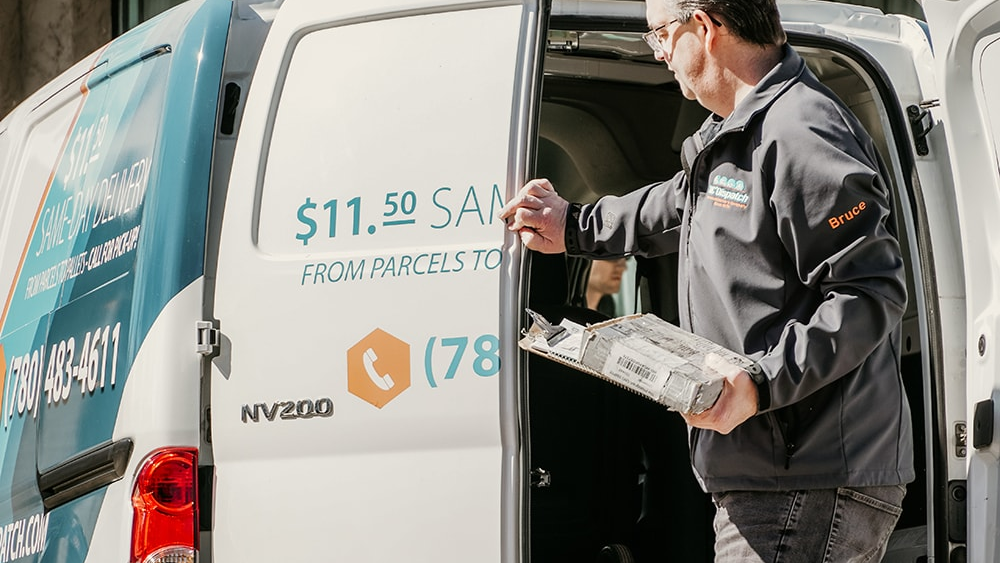
Edmonton’s layout presents specific logistical variables that national algorithms often fail to calculate accurately. For instance, a delivery originating in the Acheson industrial area destined for Sherwood Park must traverse the Anthony Henday Drive. While AI-driven national maps see a highway, local logistics experts see potential bottlenecks at the Yellowhead interchange during peak afternoon hours.
Navigating High-Density Zones
For retailers located in the downtown core or near the Ice District, standard delivery trucks are often inefficient due to parking constraints and pedestrian traffic. This is where Professional Messenger Services for High-Density Areas become essential. Small-vehicle couriers and messengers can navigate narrow alleys and park closer to building entrances, shaving minutes off every stop.
The Winter Factor in Alberta Logistics
Last-mile delivery in Alberta is heavily impacted by the October-to-April winter cycle. National carriers often experience system-wide backups when a major snow event hits the Edmonton-Calgary corridor. Local providers, however, maintain a higher percentage of on-time deliveries because their fleet is equipped for local conditions and drivers are intimately familiar with the priority plowing routes in the city.
Step-by-Step Timeline: The 4-Hour Delivery Cycle
To achieve the speed necessary to beat big-box competitors, retailers should follow this optimized timeline for same-day logistics.
- 0–30 Minutes: Order Processing
- Order is received via the e-commerce platform (Shopify, WooCommerce, etc.).
- Warehouse or store staff pick and pack the item.
- 30–60 Minutes: Digital Dispatch
- The delivery request is sent automatically to the courier via API integration.
- The closest driver is assigned based on current proximity to the store location.
- 1 Hour – 1.5 Hours: Pickup & Scan
- The courier arrives at the retail location.
- The package is scanned, triggering an automated “Out for Delivery” notification to the customer.
- 1.5 Hours – 4 Hours: Transit & Drop-off
- Driver follows a dynamically optimized route.
- The package is delivered; photo proof or digital signature is recorded.
- Customer receives a final delivery confirmation.
Utilizing Same-Day Courier Speed Advantages allows retailers to manage customer expectations through every step of this timeline.
Realistic Service Constraints and Logistics
While same-day delivery provides a significant advantage, it is governed by certain operational realities.
- Order Cut-off Times: To guarantee same-day arrival, most retailers must establish a cut-off time (e.g., 1:00 PM). Orders placed after this time typically shift to the next business day’s first run.
- Zone Limitations: Same-day rates are generally most effective within the Greater Edmonton Area. Deliveries to outlying areas like Fort Saskatchewan or Spruce Grove may involve different rate structures.
- Package Weight and Volume: Small-package couriers are optimized for items under 50 lbs. Oversized or palletized items require different equipment, such as 5-ton trucks or flatbeds, which may affect the immediate availability of a driver.
- Holiday Demand: Peak seasons like Black Friday or the week before Christmas increase the volume of local deliveries, requiring retailers to book scheduled runs in advance to guarantee capacity.
Common Mistakes in Local E-commerce Logistics
Retailers often stumble when transitioning from traditional shipping to on-demand delivery for retailers. Avoiding these errors is critical for maintaining professional standards.
- Poor Packaging for Speed: Some businesses use excessive packaging that is difficult for a courier to handle quickly. Use right-sized, secure packaging that protects the item without adding unnecessary bulk.
- Inaccurate Address Data: Entering a delivery address without a unit number or a buzzer code causes significant delays and may result in a failed delivery attempt fee.
- Lack of Communication: Customers expect to know exactly when their package will arrive. Failing to provide a tracking link through logistics software leads to increased customer service inquiries.
- Underestimating Fulfillment Time: A courier cannot deliver an item that hasn’t been packed. Ensure your internal team is staffed to meet the speed of the courier service.
What To Do If Something Goes Wrong
Logistics involves moving parts, and disruptions can occur. Clear communication is the number one factor in maintaining customer trust during a delay.
- Verify the Delay Cause: Check the tracking software to see if the delay is due to traffic, weather, or an incorrect address.
- Update the Customer Immediately: Do not wait for the customer to ask where their package is. Send an automated text or email with the new estimated delivery time.
- Contact Dispatch: If the package appears stalled, contact the courier’s dispatch team directly. Local providers offer direct phone support, which is often faster than the ticketing systems used by national carriers.
- Offer a Resolution: If a same-day delivery fails and becomes a next-day delivery, consider offering a small discount or a credit toward a future purchase to maintain the relationship.
The rise in e-commerce activity, as noted by StatCan, means that consumers have more choices than ever; a handled-well delivery error can actually build more loyalty than a perfect one.
Is your business ready for the 2026 shipping standards? Request a consultation to see how we can integrate with your e-commerce platform.
FAQ: Same-Day Delivery & Local Logistics in Edmonton
How does same-day delivery in Edmonton differ from national express shipping? National express shipping still relies on a hub-and-spoke model where packages are sorted at large regional facilities, often adding unnecessary travel miles. Local same-day delivery is point-to-point, meaning the item goes directly from your store or warehouse to the customer’s door within a few hours.
What is the best way to integrate delivery software with my online store? Most professional couriers provide API integrations for platforms like Shopify and WooCommerce. This allows delivery requests to be generated automatically the moment a customer completes a purchase, ensuring no time is lost between the sale and the dispatch of a driver.
Can local couriers handle fragile or high-value retail items? Yes, local couriers often provide higher levels of care than national carriers because packages are handled fewer times. Specialized services like messenger delivery or dedicated van runs ensure that fragile items remain secure and are not subjected to the rough handling common in automated sorting belts.
Are there weight or size limits for same-day retail deliveries? While most retail couriers focus on parcels and envelopes, providers with diverse fleets can handle larger items. It is important to specify if you are shipping small electronics or large home furnishings so that the correct vehicle, such as a 5-ton truck or a van with a lift-gate, is dispatched.
How do I calculate the ROI of offering same-day delivery? Calculate the ROI by comparing your increase in local conversion rates and repeat purchase frequency against the cost of the delivery service. Many retailers find that customers are willing to pay a premium for same-day speed, which can offset or even cover the entire cost of the courier service.
What areas are covered by Edmonton’s same-day delivery services? Typical coverage includes the city of Edmonton and surrounding municipalities such as St. Albert, Sherwood Park, Leduc, Beaumont, and Spruce Grove. Deliveries within this radius can usually be completed within a four-hour window, depending on the service level selected.
How does winter weather affect same-day delivery speeds in Alberta? While heavy snow can slow down all traffic, local couriers are better equipped to handle Edmonton’s winter roads than national carriers. Drivers adjust routes in real-time to avoid unplowed residential areas or major accidents, maintaining a higher level of reliability during the winter months.
Does local delivery help with my business’s sustainability goals? Yes. Local point-to-point delivery significantly reduces the total mileage a package travels by eliminating the need for national air or ground transport. This localized approach lowers the carbon footprint per order, which can be reported in your annual sustainability metrics.
How do I manage high-volume days like Black Friday with a local courier? Preparation is key. On high-volume days, we recommend utilizing Scheduled Delivery Services Alberta to reserve dedicated drivers in advance. This ensures your capacity is locked in, preventing the “backlog” that often occurs with national carriers during peak seasonal surges.
What is the benefit of API integration for a small Shopify store? API integration automates the communication between your store and the courier. It removes human error in address entry, provides your customers with real-time tracking links instantly, and allows for much faster dispatch times, which is essential for maintaining a four-hour delivery window.
Conclusion
Reducing shipping times for local shops is no longer just an operational goal; it is a survival strategy in the 2026 retail landscape. By leveraging local courier services in Edmonton and focusing on the Zero-Sorting Protocol, small and medium-sized businesses can offer delivery speeds that rival or exceed those of national big-box competitors. The proximity of your inventory to your customer is your greatest asset. When combined with specialized last-mile delivery in Alberta infrastructure, this proximity translates into higher conversion rates, lower shipping costs, and a dominant local market presence.
Streamline your delivery workflow and give your customers the speed they expect. Contact MC Dispatch today to set up your local same-day delivery account. Experience the difference that professional Edmonton-based logistics can make for your bottom line.